


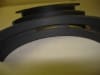
Benefit No.1 - Particle EmbedabilityTraditional rod and main bearing construction is based upon a three layer configuration composed of a steel backing, a copper-lead layer and a very thin overlay of babbitt material only .0005" - .0008" thick.
King’s bearing uses just two layers, a high strength steel backing plus a bonded layer of "Alecular" bearing material .012" - .015" thick.
Alecular material is used exclusively by King. It is an alloy of aluminum, tin, copper and several other elements. Because it is an alloy, it maintains its properties throughout its entire depth, delivering consistent and reliable performance.
Benefit No. 2 - ConformabilityMore than half of engine bearing failures are caused by metallic particles which scratch crank journals and tear or weaken thin babbitt overlays such as in the tri-metal bearing.
Since King’s Alecular bearing layer is much thicker than the babbitt overlay (.015" vs. .0008"), it provides eighteen (18) times more embedability than a tri-metal bearing to catch and hold particles so they don’t scratch the crank journals. This is especially true for particles over .0004" in diameter which cause most of the damage.
Benefit No. 3 - Temperature ResistanceThe much thicker layer of Alecular bearing material (.015" vs. .0008") allows the bearing to conform to problems such as metal to metal contact when there is mis-alignment present or the connecting rods stretch. Greater conformability means fewer bearing failures.
Benefit No. 4 - High Load CapacityThe Alecular material’s melting/fatigue point is over 11000 F, almost three times that of the thin babbitt overlay in a tri-metal bearing (400OF). This means added protection against localized overheating due to mis-alignment, detonation, overloading, loss of coolant, etc.
Benefit No. 5 - Control of Wall ToleranceAlecular bearings successfully withstand the stresses of blown, nitro-methane burning Top Fuel dragsters generating 5,000 hp at 8,000 rpm and in 700 hp circle track engines running for extended periods of time. The same metallurgical alloy is used in King’s street bearings that is used in King’s High Performance bearings, so the regular bearing user gets the advantage of the alloy developed and used in race engines.
Bearing -to- journal clearances on main and connecting rod bearings can be affected by several variables, all of which the engine builder must try to control. King has removed concerns about inconsistent shell to shell bearing wall thickness by the use of statistical control methods to keep wall thickness to very limited variation.
Other manufacturers produce bearings whose wall thickness at the crown can vary by up to + .00025". King bearings are produced using "Bull's Eye" specs which set a higher standard of controlling the wall thickness, permitting no more than + .00010" variation of the desired thickness.
The benefits of tight control of wall thickness tolerance are:
- Improved consistency of bearing to journal clearance. No more trying different bearings within a set to get the "right" fit.
- Superior eccentricity and crush relief values for a better oil "wedge" and less journal wear.
- Less taper across the bearing face, meaning superior wall stability, a more parallel wall and better oil film development.